
Tuesday, December 3, 2024

Review of the Movie- Conclave

Is Conclave’s Twist Ending Honorable, Offensive, or Just Plain Ridiculous?

It seemed like this year’s safest Oscar pick, until it revealed one final surprise.
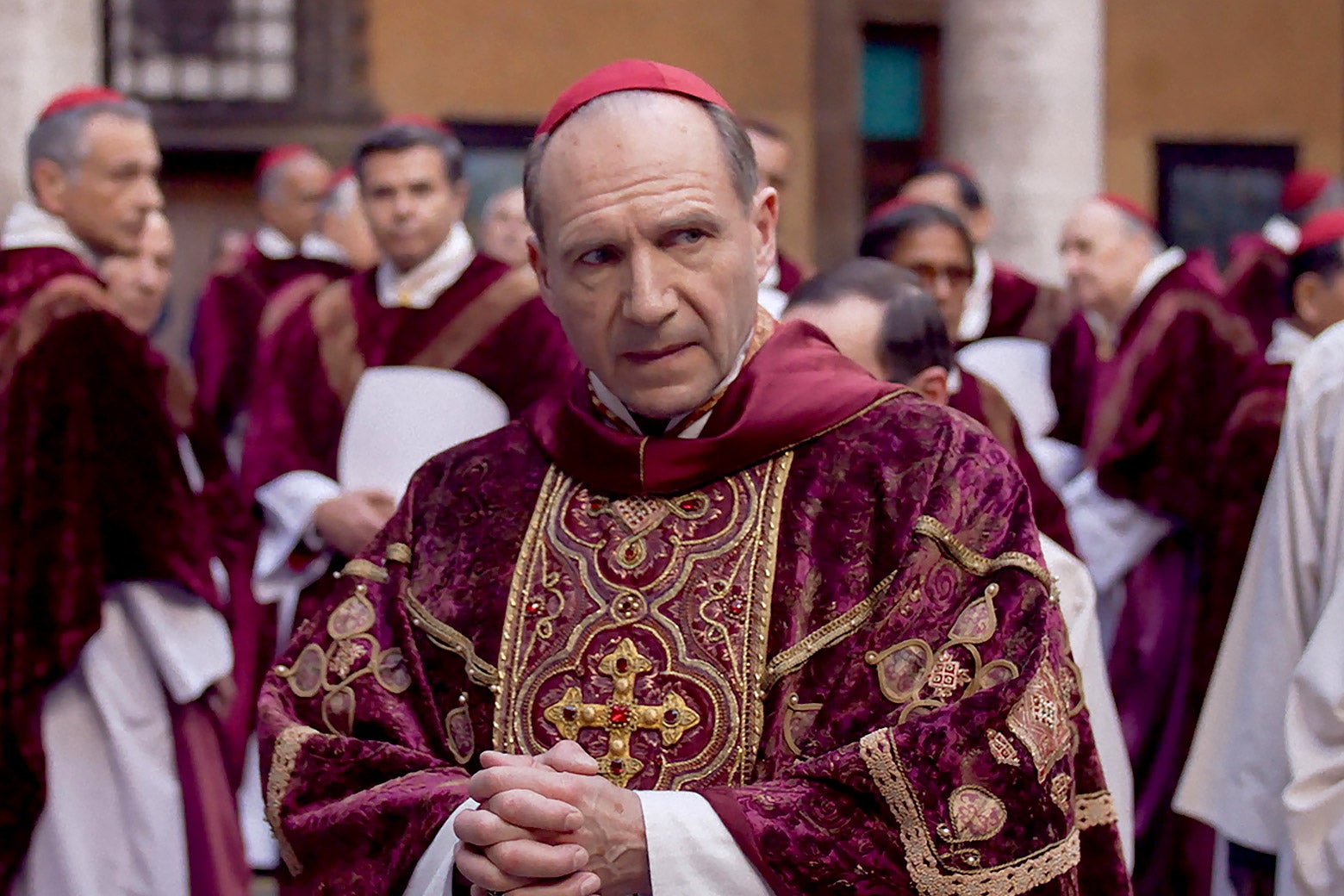
A cardinal in vestments, in a crowd of other cardinals, looks around suspiciously.
Ralph Fiennes in Conclave. Focus Features

Lawrence’s own allegiance lies with the American candidate, Cardinal Bellini (Stanley Tucci), a progressive who has made it clear he’s open to reform on issues like gay marriage and the ordination of women. But the candidate with the most support behind him is the conservative Cardinal Tedesco (Sergio Castellitto), an Italian who, once the council has been cloistered for the duration of the vote, freely shares his retrograde and racist views about the future of the church. Meanwhile, another North American contender, Cardinal Tremblay (John Lithgow), and the Nigerian candidate, Cardinal Adeyemi (Lucian Msamati), are jockeying for their own places in the field. Just as the voting is about to start, the council is joined by a young Mexican cardinal, Benitez (Carlos Diehz), about whom little is known. The conclave takes place in an atmosphere of unrest, not just among the elite clergymen of the council, but in the world outside the Vatican’s magnificently frescoed walls. The exact nature of the political violence taking place just off-screen is not explained, but does it need to be? It’s 2024, and we’re in the middle of a high-stakes election.


Read More

Conclave is not a pathbreaking or formally inventive movie, but scene by scene it’s a powerful pleasure-delivery system. The pacing of the script (by Peter Straughan, who wrote the 2011 Tinker Tailor Soldier Spy) is expertly machined to provide a fresh plot twist every 20 or so minutes, culminating in a final rug pull that’s so out of left field it provoked a mixture of gasps and giggles in the screening I attended. (More on that further on.) The film is packed with splendid performances from such reliably brilliant actors as Fiennes, Tucci, Lithgow, and, in a near-wordless role that proves there really is no such thing as a small part, a flawless Isabella Rossellini.

Conclave looks lush and painterly, with the same attention to geometrical compositions and vivid color palettes as Berger’s previous movie All Quiet on the Western Front. There were some critics, me among them, who found that Oscar winner well crafted but a tad too tastefully somber. Those critics will be pleased to find that Conclave unfolds like a trashy airport thriller, with touches of humor, a steady drip of suspense, and generous lashings of melodrama. It can verge on the grandiose, especially when the score, by Volker Bertelmann, mounts to heights so portentous as to suggest, incorrectly, that these cardinals are all secretly in the service of Satan. But the swelling strings and hairpin turns all seem like part of the ecclesiastical fun—at least up until that confounding ending, one I’m still trying to decide how to feel about weeks after seeing the movie.

First of all: One surprising thing about Conclave’s myriad revelations of clerical misconduct is that not all or even most of them involve sex scandals. There is one of those, involving a cardinal’s long-ago affair and out-of-wedlock child, and it does effectively throw that particular offender out of the running for the papacy. But the majority of the infractions committed by would-be popes in this movie have to do with money and power, not sex. A word crucial to the plot that you’ll be unlikely to hear in any other thriller released this year is simony, an archaic term for the buying and selling of church positions or privileges.

In one whispered conversation among conspiring cardinals in a stairwell, the Catholic Church’s lengthy history of covering up for child sex abusers is mentioned, and deplored in appropriately appalled tones, but it remains an abstraction: That criminal conspiracy never impinges directly on the movie’s story, and none of the assembled cardinals appears to have been implicated in any such crimes. The choice to leave out such a prominent real-life issue is understandable, given the movie’s resemblance to an Agatha Christie mystery or a game of Clue. These squabbling men of the cloth are there to be moved around like chess pieces, and the introduction of a plot element as horrific as mass child rape would make the playful use of suspense as a plot device feel flip and cruel.


The Daily Beast’s critic Nick Schager liked Conclaveless than I did, but he has some sharp observations to make about it, noting in his review that the last big twist, an eleventh-hour revelation about the cardinal who is finally elected to the papal seat, “lands with a hilarious thud.” For the audience I watched it with at least, that description is not quite accurate. The climactic reveal did provoke some scattered laughs, but those struck me as guffaws of surprise, not derision. Translated into a verbal response, that laughter might have meant something like “You got me, Berger—whatever I was expecting, it was not that.” Coming just minutes before the movie ends, this closing shocker leaves the audience almost no time to reflect on the new issue it suddenly introduces into a movie that has been mostly about backstabbing priests, the spiritual hazard of personal ambition, and the struggle between faith and doubt.

So what is that climactic reveal? Well, over the course of several inconclusive rounds of voting, the favored candidates have dropped like flies as their reputations are befouled one by one. Two dark horses emerge from this war of attrition: Cardinal Lawrence himself, who’s undergoing a crisis of faith that makes him actively dread the thought of ascending to the papacy, and Cardinal Benitez, whose quiet, principled demeanor over the tumultuous course of the conclave has steadily won over supporters. In the end, Benitez is selected, and Lawrence, pleased that a man of true faith will now be leading the church, approaches the pope-to-be to clear up just one more question, one that remains unanswered from his investigation into this mysterious newcomer’s past: Why did Benitez make and then cancel a medical appointment at a Swiss clinic years before?

In the same gentle voice that has made him an outlier amid this cacophonous band of strivers, Benitez fills Lawrence in on the details: The appointment was for an operation that would have removed his uterus. Benitez is not a trans man but an intersex person, born with external male genitalia but female internal organs, a fact he himself never knew until it was discovered during routine surgery for appendicitis. Upon learning of his unusual situation, Benitez consulted with the now-deceased pope about how to proceed, and decided to forgo the hysterectomy and continue to live as the ambiguously sexed individual God made him. The papal name Benitez chooses for himself underlines his refusal to regard this choice as an error, a deception, or a sin: He requests to be known as Pope Innocent.

Typing this out in prose form, I can see why the final twist occasioned both laughter and some puzzlement in the theater. It’s provocative without quite being coherent, raising issues of gender identity and the place of LGBTQ+ people and women in the hierarchy of the church that the movie up till then has treated mainly as subjects for ideological debate rather than lived bodily experiences. There’s no question we’ve come a long way since 1992’s now painfully dated The Crying Game, in which the startling midmovie gender reveal—that the woman the protagonist is falling in love with is trans, a fact she thought he already knew—causes him to slap her in the face, then run to the bathroom to vomit before rushing out of her flat. (The two later reconcile and rekindle their courtship, which may be even worse.)

Far from feeling disgusted or tricked, Conclave’s Cardinal Lawrence appears pleased and maybe even amused to know that the next pope will be an intersex person—but why? Supposing that Benitez continues to live as a man, with the status of his internal organs known only to himself and a few confidants, how are we to assume he will lead the church differently than a cis male pope would have, given that the discovery of his secret would presumably lead to his immediate ouster? If there were a Conclave II, would the story be about an intersex pope struggling to come out of the closet?

Friday, November 29, 2024

Japanese-American Actor- Sessue Hayakawa


Considering how poorly Asian men are portrayed in Hollywood, it’s surprising to learn about Sessue Hayakawa, a Japanese actor who became one of the biggest stars during the American silent era of the 1910s.

He became one of Hollywood’s first sex symbols after starring in the film, The Cheat (1915) in which he plays a cruel villain (there’s a scene in which he literally brands a woman). Despite his portrayal, Hayakawa became extremely popular with American women for his “broodingly handsome” good looks. At one point, he was the highest paid actor in Hollywood (making over $3,500 a week), and his fame was on par with that of Charlie Chaplin.
By the 1930s, Hollywood had set strict moral guidelines called the Hays Code which prohibited interracial love to be portrayed on screen. As a result, Hayakawa continued to be cast as either a villain or a “forbidden lover” since most of his costars were white women.
In 1937, Hayakawa went to France to star in a French film, but ended up being trapped in the country when World War 2 broke out. He sold watercolor paintings to financially support himself and joined the French resistance to help fight the Germans.
In 1949, Hayakawa—upon reflecting on his career—mentioned, "My one ambition is to play a hero".
He never really got that chance but did end up being nominated for best supporting actor for his role in The Bridge on the River Kwai (1957) in which he plays an “honorable villain” in charge of a Japanese prison camp in Thailand.
Upon retirement, Hayakawa became a Zen master and dedicated his life to Zen Buddhism. He died at the age of 87 in 1973.


Review of Brokeback Mountain


Brokeback Mountain (2005), directed by Ang Lee, is a poignant exploration of love, identity, and societal constraints set against the backdrop of the rugged Wyoming mountains. Adapted from Annie Proulx's short story, the film tells the bittersweet tale of two young men, Ennis Del Mar (Heath Ledger) and Jack Twist (Jake Gyllenhaal), who develop a profound and complicated bond while working as ranch hands in the 1960s.
Ledger and Gyllenhaal deliver extraordinary performances, embodying the internal struggles and deep affection of their characters with remarkable subtlety and raw emotion. Ledger's portrayal of the stoic and conflicted Ennis is particularly heartbreaking, while Gyllenhaal captures Jack's yearning and optimism with poignant vulnerability.
The film's cinematography by Rodrigo Prieto is stunning, using sweeping landscapes to mirror the characters' isolation and yearning for freedom. Gustavo Santaolalla's hauntingly beautiful score enhances the emotional depth of the narrative, leaving a lasting impression.
At its core, Brokeback Mountain is a story about love—its power, its pain, and its resilience in the face of societal prejudice. Ang Lee masterfully examines the complexities of relationships and the devastating effects of repression, creating a narrative that feels both universal and deeply personal.
The film also raises important questions about masculinity, societal expectations, and the cost of living authentically. Its unflinching portrayal of the challenges faced by LGBTQ+ individuals in a less accepting era makes it both timeless and culturally significant.
Brokeback Mountain is a tender, tragic masterpiece that lingers in the heart long after the credits roll, a testament to the enduring power of love and the courage it takes to embrace it fully.


Friday, November 22, 2024

Leonardo Da Vinci Documentary from PBS


I watched this 2-part series the other day. I highly recommend it. Enjoy!    

https://www.pbs.org/kenburns/leonardo-da-vinci/

Movie Review: Call Me By Your Name

I saw this movie, when it was first release. I enjoyed it very much. The following is a review that I have recently read in my Facebook Page and love sharing it with you.

"Call Me by Your Name (2017), directed by Luca Guadagnino, is a masterpiece of tenderness, longing, and the aching beauty of first love. Set in the sun-drenched countryside of northern Italy during the summer of 1983, the film immerses viewers in a world where time seems to slow, allowing every glance, touch, and word to carry profound weight.
The story follows Elio Perlman (Timothée Chalamet), a precocious 17-year-old navigating the complexities of adolescence. His life takes an unexpected turn when his family welcomes Oliver (Armie Hammer), a charismatic graduate student, for a summer residency. What begins as subtle tension between Elio and Oliver gradually unfolds into a love story that is both tender and devastatingly raw.
Chalamet delivers a performance that is nothing short of extraordinary. His portrayal of Elio’s inner turmoil and quiet yearning feels heartbreakingly authentic, particularly in the film's final moments, where his silent grief lingers long after the credits roll. Hammer’s Oliver, meanwhile, is magnetic and enigmatic, embodying the fleeting intensity of a summer romance.
Guadagnino’s direction transforms the lush Italian setting into a character of its own, with every frame exuding warmth, sensuality, and nostalgia. The film's dialogue, adapted from André Aciman’s novel, is lyrical yet natural, capturing the intimacy of stolen moments. Sufjan Stevens’ haunting soundtrack amplifies the emotional resonance, particularly the track Mystery of Love, which feels like a poetic extension of the narrative.
Call Me by Your Name is more than a love story; it is an ode to vulnerability, the impermanence of joy, and the bittersweet pain of memory. It leaves you longing for the simplicity of youth while reminding you of the courage it takes to love fully, even in the face of inevitable loss. It’s a film that lingers, a tender whisper etched into the soul".

Accolades-From Wikipedia

Chalamet's performance received widespread acclaim and earned the 22-year-old a nomination for the Academy Award for Best Actor in a Leading Role, making him the third-youngest nominee for the award.

The National Board of Review and the American Film Institute selected Call Me by Your Name as one of the top 10 films of the year.  At the 90th Academy Awards, it was nominated for Best Picture, Best Actor (Chalamet), Best Original Song("Mystery of Love"), and Best Adapted Screenplay, and won the last.

Chalamet became the third-youngest Best Actor nominee and the youngest nominee since 1939, and Ivory became the oldest winner in any competitive category. The film received four nominations at the 71st British Academy Film Awards, including Best Film and Best Direction, and won Best Adapted Screenplay for Ivory. At the 75th Golden Globe Awards, it was nominated for Best Motion Picture – Drama, Best Actor – Motion Picture Drama for Chalamet and Best Supporting Actor for Hammer.

The film received eight nominations at the 23rd Critics' Choice Awards; Ivory won Best Adapted Screenplay. The film led the 33rd Independent Spirit Awards with six nominations, winning Best Male Lead for Chalamet and Best Cinematography for Mukdeeprom.  At the 24th Screen Actors Guild Awards, Chalamet was nominated for Outstanding Performance by a Male Actor in a Leading Role. The film won the GLAAD Media Award for Outstanding Film – Wide Release at its 29th ceremony. In Italy, Fasano won Best Editing at the 73rd Nastro d'Argento Awardsand 33rd Golden Ciak Awards. The National Board of Review, the Gotham Independent Film Awards, and the Hollywood Film Awards each gave Chalamet its Breakout Actor Award.

Related Posts Plugin for WordPress, Blogger...